The complete guide to Saint-Denis
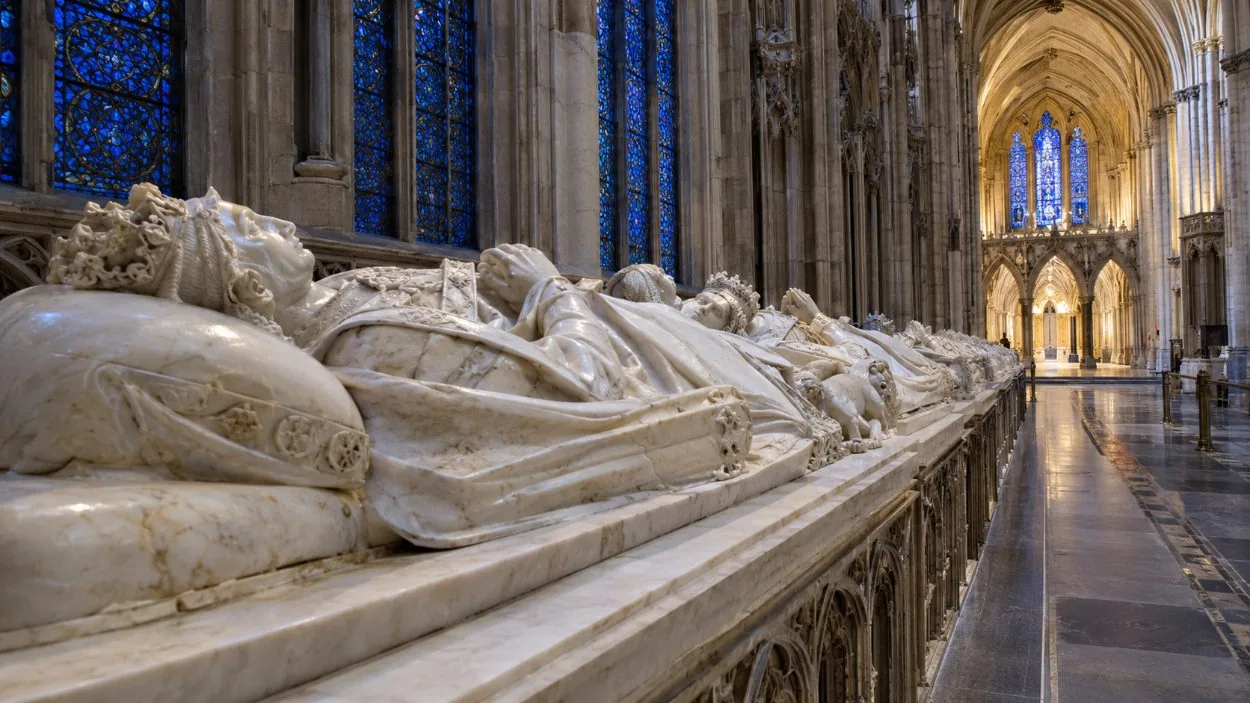
I’ve lived on rue Gabriel-Péri since 1989 and pass the basilica every day. I do my shopping on Tuesdays and Fridays at place Jean-Jaurès, three minutes from the façade, and I always hear the same conversation : people come out, happy, saying it was beautiful and quiet. They visited the nave. They didn’t see a single king. This site exists to say that sentence before the visit, not after.
Two buildings in one
The basilica is an active church, the cathedral of the Diocese of Saint-Denis since 1966. Its nave is freely accessible, without a ticket, like any parish. It is also a national monument managed by the Centre des monuments nationaux, and this part requires payment: the choir, the ambulatory, the transept with the recumbent figures, the crypt, plus the construction site of La Fabrique de la Flèche. All the tombs are behind this boundary. The cheapest ticket among the major Gothic monuments in Île-de-France, and free for those under 18: the categories are listed on the free admission page.
What Suger invented here
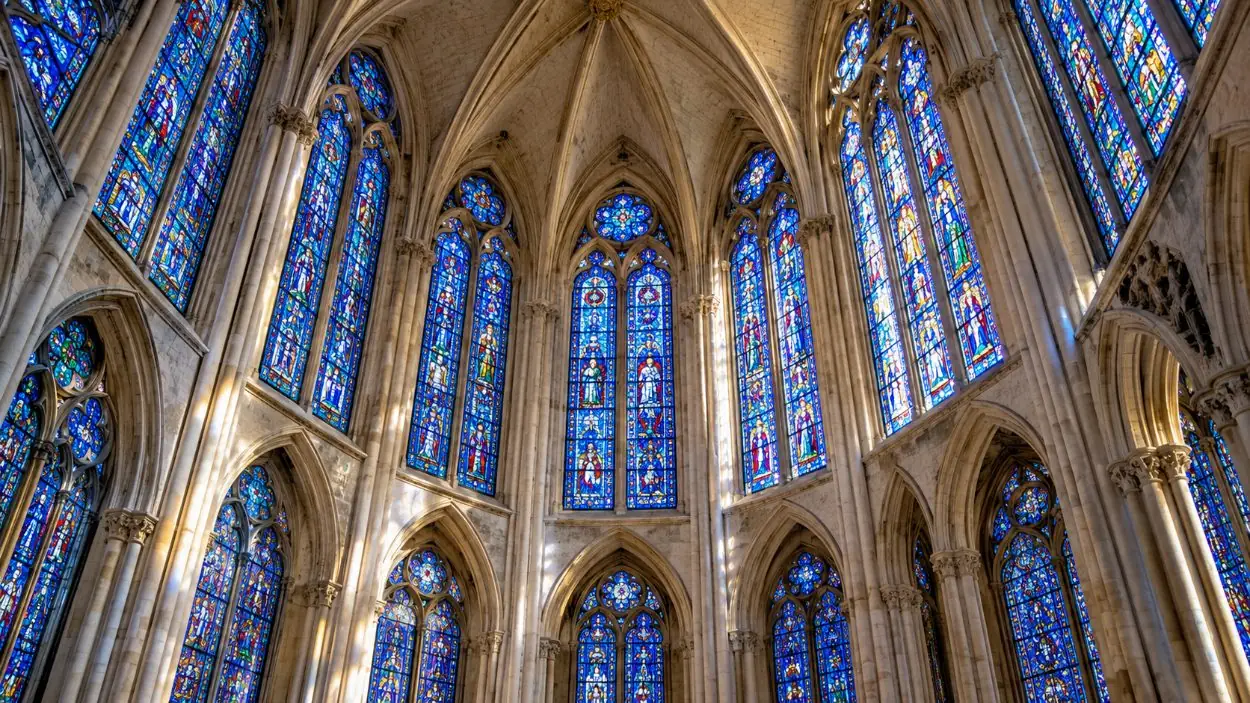
Abbot Suger directed the abbey from 1122 to 1151. The choir he had built was consecrated on 11 June 1144, marking the birth of Gothic architecture: pointed arches, ribbed vaults, radiating chapels open to one another, stained glass where there was once a wall. His doctrine is summed up in two Latin words, lux nova, the new light. Everything later called Gothic stems from this ambulatory. The nave and transept were rebuilt from 1231 under Saint Louis by Pierre de Montreuil. More details are on the page dedicated to Suger.
The bodies are not where you think
It must be said plainly. Depending on the monument, 40 kings, 26 queens, 60 princes and princesses, and around ten servants of the monarchy were buried here, from Dagobert in 639 to Louis XVIII in 1824. But in 1793, by decree of the Convention, the tombs were opened; the official reason was to recover the lead from the coffins for the war. The remains were thrown into two mass graves north of the church, with lime. In 1817, Louis XVIII had them exhumed: as it was impossible to reassign them, they were placed mixed together in an ossuary in the crypt, behind a plaque listing the sovereigns. What we see today, then, are monuments and recumbent figures, not intact burials. It’s best to know this before standing in front of the plaque. The full account is on the 1793 page and on the crypt page.
Two clarifications, as I’m asked about them every week. Marie-Antoinette’s head is not lost: she was buried with her body in the Madeleine Cemetery and transferred with it in January 1815, and Louis XVIII commissioned two kneeling funerary statues for the couple, by Edme Gaulle and Pierre Petitot. As for the heart of Louis XIV, sold as pigment and then swallowed by an English collector, this is a persistent and unverifiable legend; his body was among those destroyed in 1793. See the Louis XIV page.
The recumbent figures and the transi
Over 70 recumbent figures and tombs, the world’s largest collection of funerary sculpture from the 12th to the 16th century. The ones I point out: Dagobert, whose 13th-century tomb tells his story in sculpted comic-strip form; Charles V the Wise; Bertrand du Guesclin, lying at his sovereign’s feet; Louis XII and Anne of Brittany; Francis I and Claude of France beneath their triumphal arch; Henry II and Catherine de’ Medici. And above all, the transi, the statue of the naked, emaciated body placed beneath the clothed recumbent figure. This is what shocks children and what adults still talk about on the tram. Details are on the recumbent figures page.
The best time to visit
Two pitfalls, always the same. The first: the monument closes during religious services, which spoils Sunday mornings and holidays. The second: the guided tour in French is included with the ticket, from Monday to Saturday at 11:00 and 15:00, and on Sundays at 12:30 and 15:00, lasting about 1 hour 30 minutes, and almost no one knows about it. This is by far the best thing here. Confirm the time on-site the same day and make sure to be there. In January, the ambulatory is swept by a constant draught: bring a coat. On Thursday mornings, school groups occupy the transept. Seasonal opening times are on the opening times page, and the best slot is on the best time to visit page.
What I would book
The Royal Necropolis ticket, arriving before 11 am to catch the included guided tour, followed by La Fabrique de la Flèche: allow 2 hours instead of 1 hour. Note that this workshop is closed on Mondays, while the necropolis remains open that day. If your schedule doesn’t allow waiting for the 11 am tour, the audio tour on your smartphone will do the job, provided you download the app before leaving and bring your own headphones, which are not provided; it’s a recent offering with very few reviews, just so you know. If you’re visiting several Parisian monuments, Saint-Denis is included in the Paris Museum Pass. For the same day, the Stade de France is just one tram stop away, and Sainte-Chapelle shows where Suger’s vision led. Finally, Montmartre is the other side of the same story: it’s the hill where Denis was beheaded around 250, six kilometres south of here.
Ready to book ?
The royal necropolis entry ticket grants access to the choir, ambulatory, transept, crypt and La Fabrique de la Flèche from Tuesday to Sunday. The six options are compared on the tickets page, and this ticket in detail on its own page.
Frequently asked questions
Does this guide replace the guided tour ?
No. This page prepares the visit ; the lecturer tells the story on-site, for about 1 hour 30, included in the ticket. See guided tours.
How much time should I allow in total ?
One hour for a self-guided visit, 1 h 30 with the guided tour, two hours with the spire construction site. The details are on the visiting times page.
Where should I start if I only have one hour ?
Suger’s choir, then the transept with its recumbent figures, then the crypt. In that order, and without skipping the crypt. The itinerary is on the what to see page.