Who is buried at Saint-Denis?
What “buried here” means
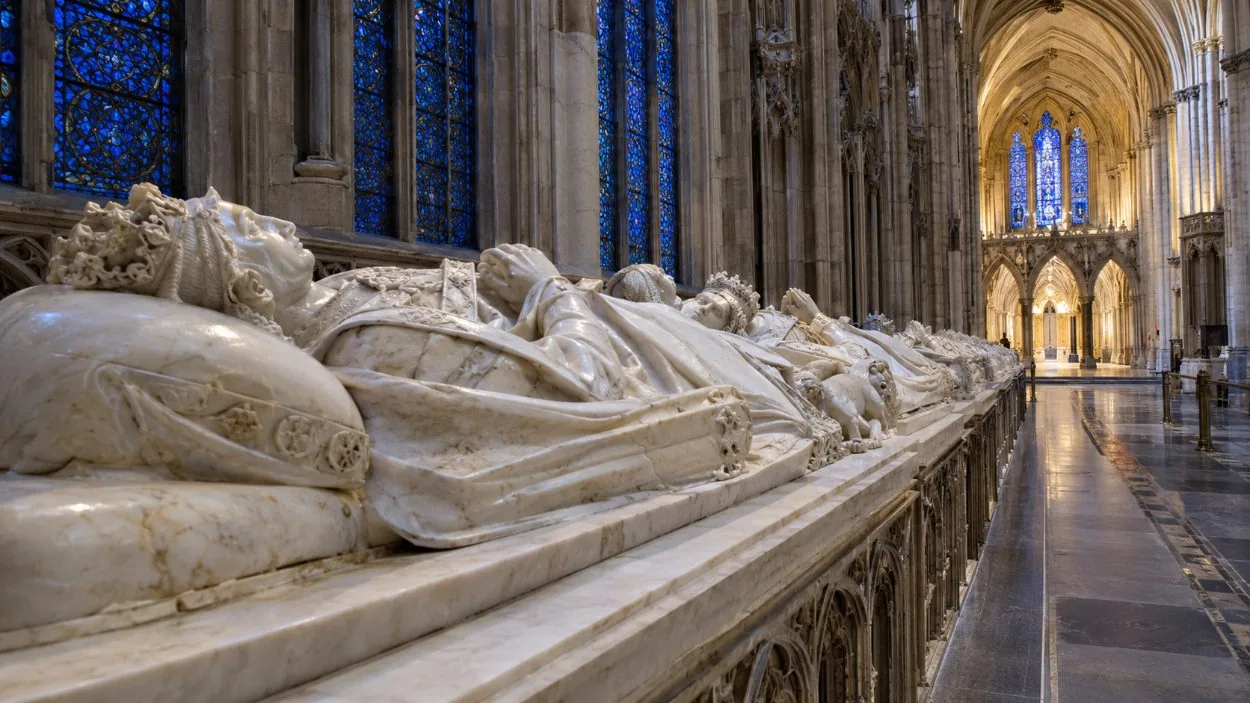
Let’s start here, because everything else depends on it. For eleven centuries, French sovereigns were buried at Saint-Denis. In 1793, by decree of the Convention, the tombs were opened. The official reason was to recover the lead from the coffins for the war. The remains were thrown into two mass graves north of the church, with lime. In 1817, Louis XVIII had these bones exhumed; it was impossible to reattribute them, and they were placed, mixed together, in an ossuary in the crypt, behind a plaque listing the sovereigns.
So: yes, these people are here. No, there is no “tomb of Marie-Antoinette” in the sense that one understands the word in a cemetery. There is a monument representing her, and somewhere behind a plaque, a mixture of bones that no one can sort anymore. I find that saying this enhances the visit rather than spoiling it: we look at the gisants for what they are, an unparalleled gallery of funerary sculpture, and the ossuary for what it is, a rather brutal end to history. The full account of 1793 is on the desecration page, and the crypt on the crypt page.
The names people look for
Dagobert, who died in 639, is the first king buried on the site and the starting point of the whole story. His monument, from the 13th century, depicts in sculpted comic-strip form the journey of his soul: it is one of the most unusual objects in the monument, and I describe it on the gisants page.
Clovis and Childebert close the Merovingian chapter. Charles V the Wise provides the first true portrait: a recognisable face, made during his lifetime. Louis XII and Anne of Brittany occupy the double Renaissance tomb, where the sovereigns appear twice, as praying figures above and as naked transis below. Francis I and Claude of France rest beneath a sculpted triumphal arch, the most monumental piece in the transept. Henri II and Catherine de Medici follow, with the same two-tiered arrangement.
And then there is Bertrand du Guesclin, who was not a king. Constable of France, he is buried at the feet of the king: the presence of a servant of the monarchy among the sovereigns is one of the details that most intrigue visitors, and it is also what “around ten servants of the monarchy” means in the official count.
Louis XVI and Marie-Antoinette, the special case
They have not always been here. Guillotined in 1793, they had been buried in the Madeleine cemetery. In January 1815, their remains were sought, identified, and brought back to Saint-Denis. Louis XVIII had two funerary praying statues erected for them, works by Edme Gaulle and Pierre Petitot. Paradoxically, they are thus two of the rare sovereigns whose remains were transferred after the desecration, rather than scattered by it.
A word on the question I am most often asked, that of Marie-Antoinette’s head: it was buried with her body in the Madeleine cemetery and transferred with it. There is no lost head, no missing skull, no mystery. I answer in more detail on the page dedicated to her and on that of the royal couple.
Louis XIV and the legend of the heart
Louis XIV was buried in Saint-Denis in 1715. His body was among those destroyed in 1793. What you see today is not his tomb, and I repeat this because visitors instinctively look for “the tomb of the Sun King.” As for the story of his heart sold as pigment to a painter and then swallowed by an English collector: it is an unverifiable anecdote, a persistent legend, not an established fact. I recount it as such on the Louis XIV page, along with the context of his death, and the more stark questions about the ends of reigns are addressed on the page about deceased kings.
What works
- Over seventy recumbent statues and tombs, the world’s largest collection from the 12th to the 16th century
- Eleven centuries of dynastic continuity, from Dagobert in 639 to Louis XVIII in 1824
- Names everyone knows, gathered in a single transept
- An included guided tour that explains them in order
Good to know
- The tombs were emptied in 1793: these are monuments, not graves
- The bones are mixed in the crypt ossuary, not reassigned
- None of these tombs are visible from the freely accessible nave
- The monument closes during services
Visit the crypt last, not first. Seeing the recumbent statues first, then the ossuary plaque, gives the visit the chronological order of history. In the reverse order, you look at faces without knowing what became of them.
Why them, why here
The reason dates back to a martyr beheaded around 250 on the hill of Montmartre and the tomb that formed around him. This is the subject of the page why the kings at Saint-Denis, and of that of Saint Denis himself. The rest of the tour, in the order you walk, is on what to see.
View the tombs
Reminder: what you’re booking above is entry to the royal necropolis. The nave, however, remains open without a ticket, as in any church in the diocese.
Frequently asked questions
How many kings are buried in Saint-Denis?
Forty kings, twenty-six queens, sixty princes and princesses, and around ten servants of the monarchy, from Dagobert in 639 to Louis XVIII in 1824. See why here.
Are the bodies still in the tombs ?
No. The tombs were emptied in 1793 and the remains, recovered in 1817, are mixed together in an ossuary in the crypt. See the desecration of 1793.
Is Marie-Antoinette really here ?
Yes, brought back from the Madeleine cemetery in January 1815 with Louis XVI, beneath two praying statues. Her head was buried with the body. See her page.
Are there any non-royal individuals ?
Yes, around ten servants of the monarchy, including the constable Bertrand du Guesclin, buried at the feet of the king. See the gisants.
Where can the remains be seen ?
In the crypt, behind a plaque listing the sovereigns. The bones themselves are not visible. See the crypt and the ossuary.