Why does Saint Denis carry his head?
What the legend says
Beheaded on the hill with two companions, Denis stands up, takes his head, washes it at a fountain and sets off to the north. He walks until the place where he wishes to be buried, then collapses. A saint depicted in this way, head under his arm, is called a cephalophore; the motif is found throughout medieval sculpture. The very name of Montmartre comes from mons martyrum, the hill of the martyrs.
What history says
The two layers must be separated, and I always do so when asked about it at the market. The tomb of a venerated martyr is attested on the site as early as the 3rd or 4th century: there was indeed a very ancient Christian burial here that attracted pilgrims and later the abbey. The walk with the head, however, is a legend written down in the 9th century, several centuries after the events. The two statements are not of the same order.
Why this explains the basilica
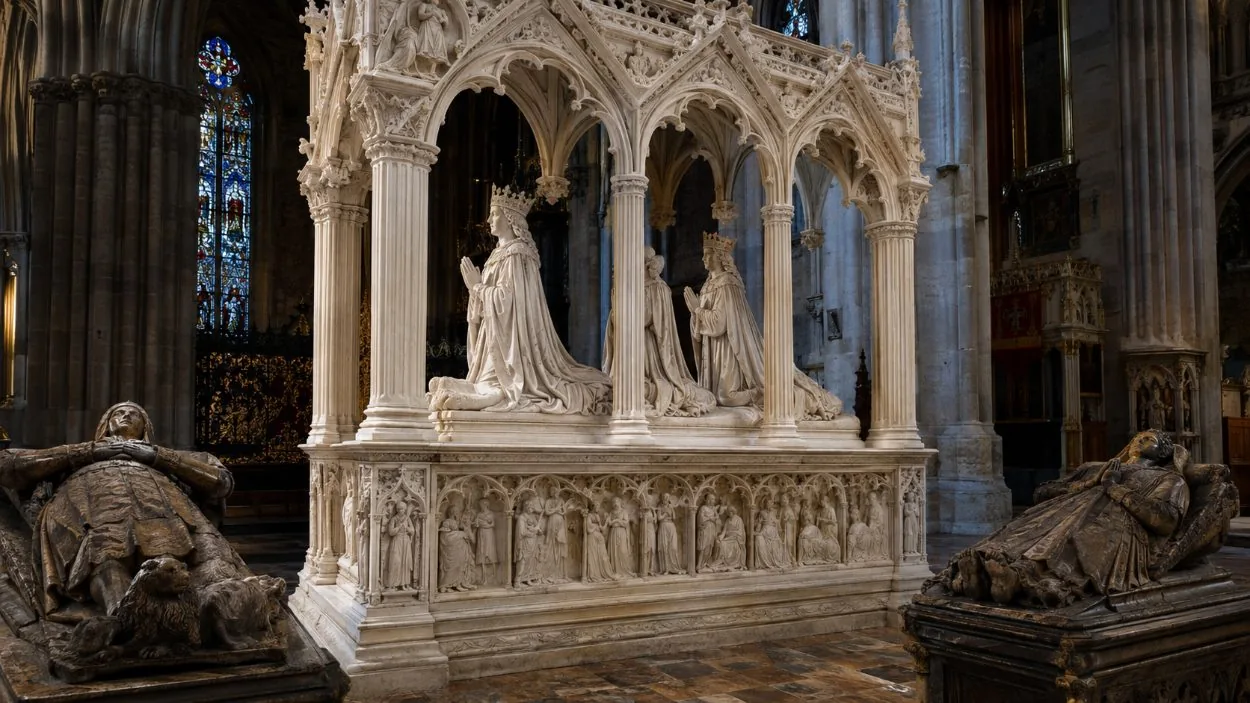
Without this martyr’s tomb, there would be no abbey in this place, and thus no royal necropolis. Kings were buried near the saint to place themselves under his protection, from Dagobert in 639 to Louis XVIII in 1824. The entire logic of the site lies in this continuity: see why the kings of France are here and who is buried here.
The two ends of the same story
Montmartre and Saint-Denis are linked by this journey: the hill where the head falls and the place where the body comes to rest. Visiting both in the same day offers a coherence that few Parisian visits provide. A guided walk on the hill can be booked separately: see the Montmartre page. For Saint-Denis, the nave is free to enter, and the necropolis requires a ticket: see the necropolis ticket.
Look for depictions of Denis carrying his head: they are not all in the same place in the church, and spotting them is a great activity for an eight-year-old.
Frequently asked questions
Did Saint Denis really walk with his head?
This is a legend written in the 9th century. What is attested is a martyr’s tomb on the site as early as the 3rd or 4th century. See the origin of the place.
What is the connection between Montmartre and Saint-Denis?
Montmartre is the hill of the decapitation, Saint-Denis the end of the journey, about six kilometres further north. See the walk in Montmartre.
Can you see Saint Denis’s tomb in the basilica?
The site originated around the burial place of a martyr, but what you visit today is the royal necropolis and the crypt: see the crypt.