Where are Louis XVI and Marie-Antoinette?
Twenty-two years at the Madeleine cemetery
After 1793, the two bodies were buried in an ordinary Parisian cemetery, without a monument. It was not until the Restoration that efforts were made to find them, identify them, and return them to Saint-Denis in January 1815. The operation was as much political as it was funerary: the aim was to re-establish dynastic continuity in the place that had staged it since Dagobert. Why here and not elsewhere is explained on the page about the kings of France.
Two statues, not two tombs
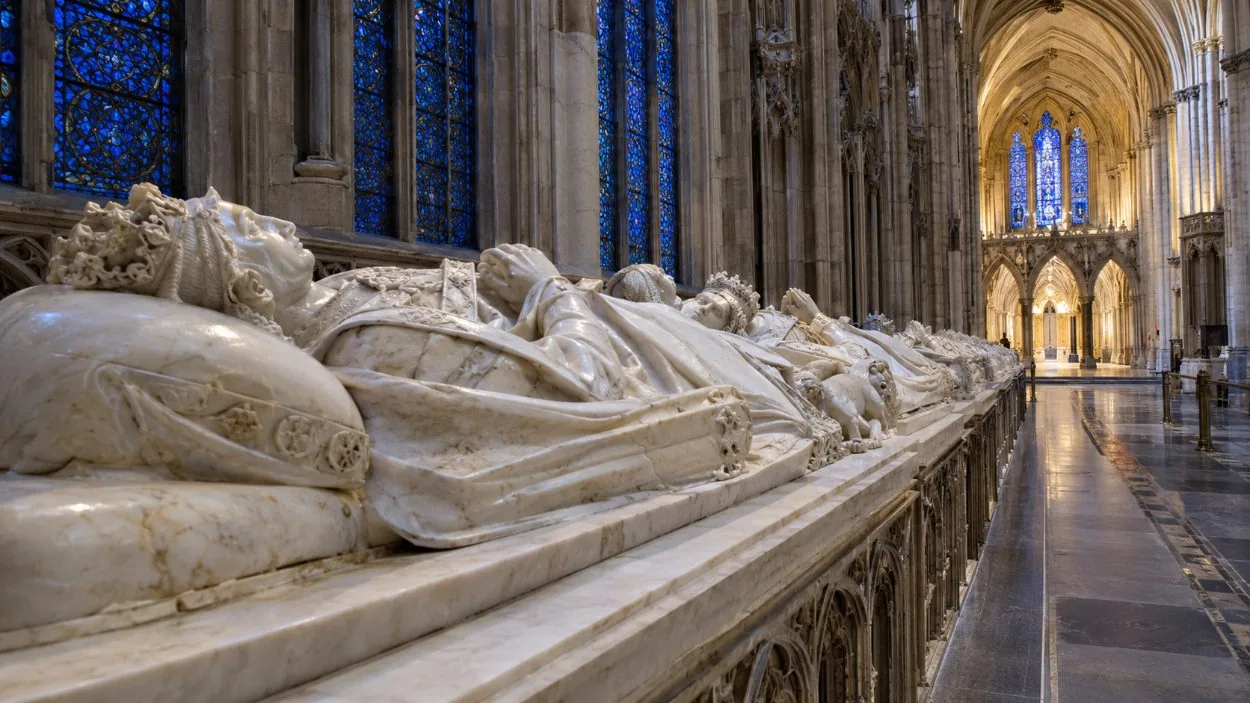
Edme Gaulle and Pierre Petitot sculpted the two kneeling figures, hands joined. They belong to a different category of objects than medieval gisants: these are praying statues, commemorative monuments created long after death and with no direct connection to the location of the remains. The difference between a gisant, a praying statue, and a transi can be clearly seen by walking around the transept: see the gisants, one by one.
So, what about the remains?
They are in the vaults and, for those recovered from the 1793 pits in 1817, in the ossuary of the crypt, mixed with those of dozens of other sovereigns. The ossuary plaque lists the names; it does not specify who is where, because no one knows. This is the point most often glossed over on web pages. See the crypt and the ossuary and the question of the head.
How to see them without taking the wrong entrance
The two praying statues are in the royal necropolis, so on the paid side. The nave, however, can be crossed freely and does not provide access to the transept with the tombs. Allow one hour for a self-guided visit, an hour and a half with the guided tour included. Practical details are available on the necropolis ticket and on the duration of the visit.
Look at the hands and faces: these statues date from the Restoration, not the 18th century. They tell the story of 1815 as much as 1793.
Frequently asked questions
Are the bodies of Louis XVI and Marie-Antoinette at Saint-Denis?
Yes, brought back from the Madeleine cemetery in January 1815, but without any visible individual burial. See who is buried here.
What do the two kneeling statues represent?
Praying figures commissioned by Louis XVIII and sculpted by Edme Gaulle and Pierre Petitot. Other funerary forms are on the page of gisants.
Do you have to pay to see them?
Yes, they are in the paid section. Free admission categories exist: see what is free.