The recumbent statues, one by one
The transi, first of all
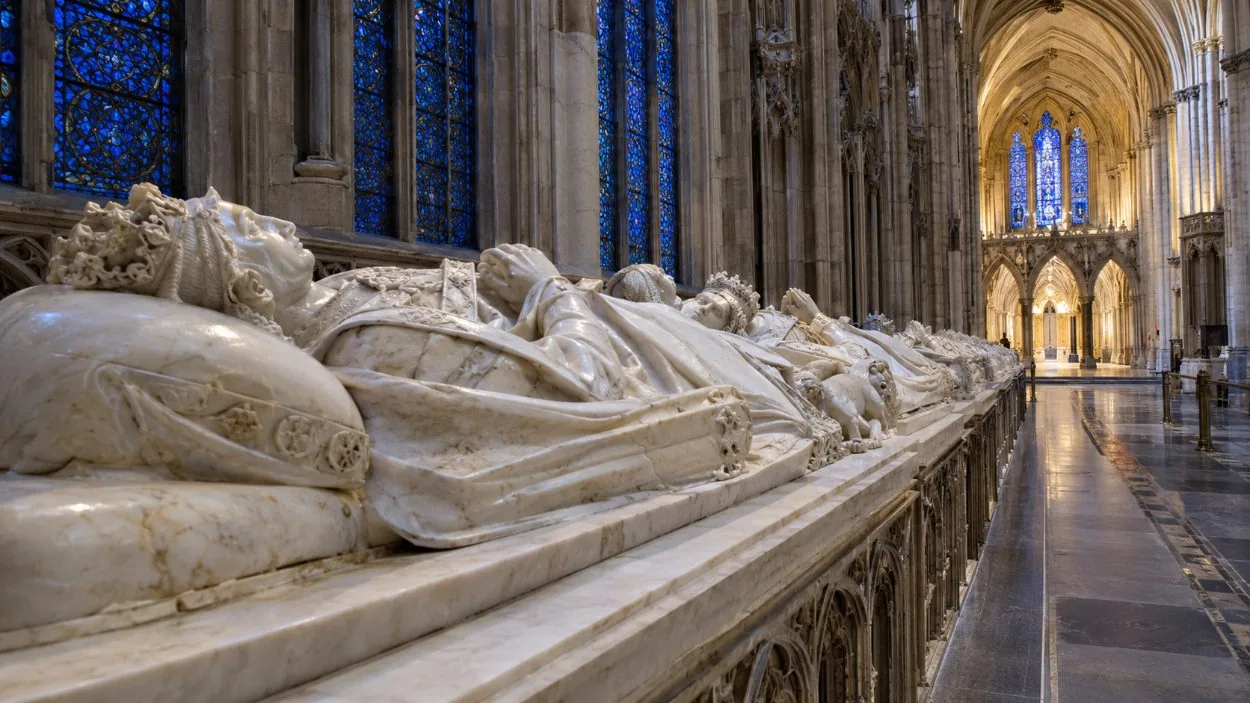
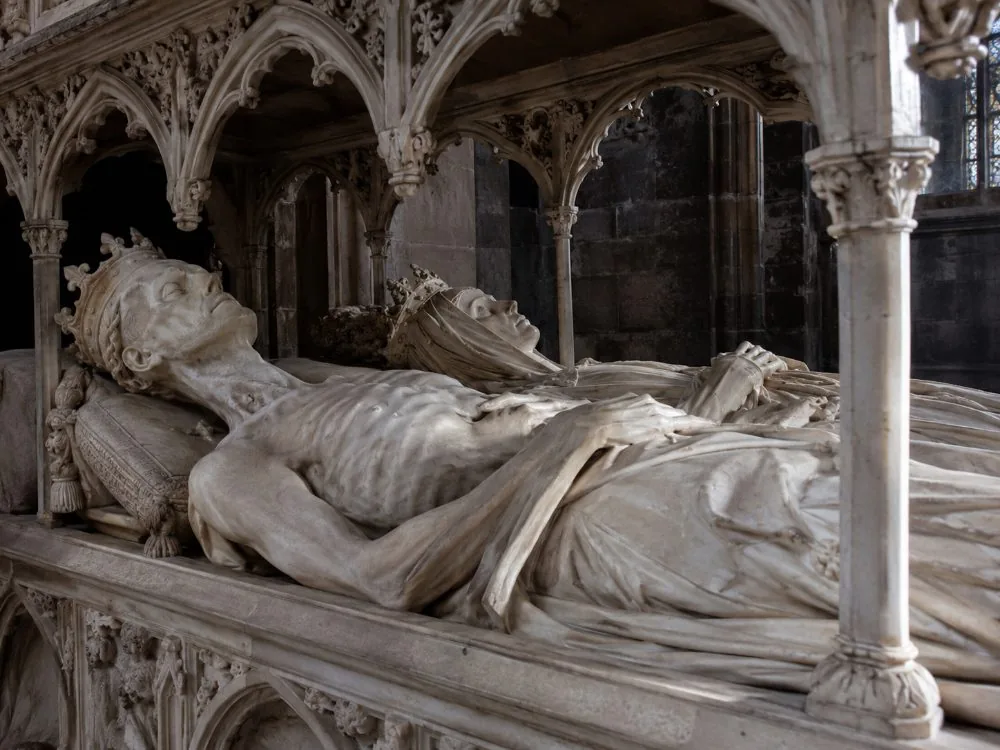
If you only remember one word from this page, let it be this one. A transi is the statue of the naked, emaciated body placed beneath the clothed effigy. The same sovereign is shown twice : above, in glory, crowned, in prayer ; below, as a corpse, with a hollowed stomach, protruding ribs, and an open mouth. Children stop dead in front of these sculptures, and adults still talk about them on the metro ride home. It’s not a gratuitous effect : it’s the Renaissance placing side by side what the monarchy claims to be and what the body becomes. I discuss it on the page about visiting with children, because it’s exactly what captivates eight-to-twelve-year-olds.
Dagobert, 13th century
The monument of Dagobert, who died in 639, was sculpted six centuries after his death. It depicts, in superimposed scenes like a comic strip, the journey of the king’s soul : demons carry it away in a boat, Saint Denis intervenes, and the soul is saved. You can spend ten minutes following the registers from bottom to top. It’s also the monument that best illustrates the purpose of the necropolis : to tell a story, not just to preserve a body. The explanation is on the why the kings are here page.
Clovis and Childebert
Two Merovingian figures, also sculpted long after their deaths, during the major 13th-century campaign commissioned to align the reigns. These are not portraits : they are symbols. Smooth faces, attributes, identical poses. What mattered at the time of their creation was that they were there, in a line, and that the line stretched far back.
Charles V the Wise
Here, the change is visible to the naked eye. Charles V is the first whose effigy resembles someone : a long nose, heavy eyelids, a distinctive mouth. Funerary sculpture ceases to be an emblem and becomes a portrait. When you move from Clovis to Charles V in just a few metres, you traverse two centuries of art history without leaving the transept.
Louis XII and Anne of Brittany
The Renaissance double tomb, and for many visitors the highlight of the visit. A whole marble structure, with the two sovereigns kneeling in prayer on top, and inside, lying down, their naked transis. You have to lean in to see them. The body of Anne of Brittany, with the embalming incision sculpted into the marble, is one of the most striking and unsettling things in the monument. Standing before this piece, you understand why it’s called the world’s greatest collection of funerary sculpture.
Francis I and Claude of France
A sculpted triumphal arch, literally : the tomb borrows the form of an ancient Roman monument. Worshippers at the top, transis below, battle bas-reliefs on the sides. It’s the largest piece in the transept and the one where groups linger the longest. The included guided tour, described on the guided tours page, devotes real time to it : it’s the kind of tomb you don’t fully appreciate without someone pointing out what to look at.
Henri II and Catherine de Médicis
Same principle, another couple, and a complicated commission story: during her lifetime, Catherine de Médicis had her own transi made and remade until it suited her. Look at the two levels in order, the praying figures then the transis, not the other way around: that is the meaning the sculpture intended to convey.
Bertrand du Guesclin, the intruder
The Constable of France was not a king. Yet he is here, buried at the feet of the king, with his recumbent figure. This is the most visible trace of the ten or so servants of the monarchy buried in the necropolis alongside forty kings, twenty-six queens and sixty princes and princesses. The full count is available on who is buried.
And Louis XVI and Marie-Antoinette
They do not have a medieval recumbent figure but two funerary praying statues, commissioned by Louis XVIII after the return of their remains in January 1815, and created by Edme Gaulle and Pierre Petitot. Different style, different century, and an obvious political function. See the royal couple's page.
What works
- Over seventy tombs gathered in a single transept
- Four centuries of funerary sculpture visible by walking fifty metres
- The transis, which you will not see anywhere else in such numbers
- Photography permitted without flash
Good to know
- The tombs beneath these monuments were emptied in 1793
- Without comment, many tombs look alike
- The transept is cold in winter : the wind comes through the ambulatory
- School groups occupy the large rooms on Thursday mornings
Lean in. Half of the interest of the great Renaissance tombs is inside, beneath the praying figures, and is completely missed if you stay standing and look from afar. Louis XII, Anne of Brittany, Francis I: bend down.
Where they are located in the tour
The transept and the ambulatory, after Suger’s choir, before descending to the crypt.
The complete order is on what to see, in order, and what remains beneath the slabs is on the crypt and the ossuary.
View the recumbent figures
Reminder: what you’re booking above is entry to the royal necropolis. The nave, however, remains open without a ticket, as in any church in the diocese.
Frequently asked questions
What is a transi?
The statue of the naked, emaciated body placed beneath the clothed recumbent figure: the same sovereign shown in his glory and then as a corpse. See the tour.
How many recumbent figures does the basilica have?
Over seventy recumbent figures and tombs, from the 12th to the 16th century, the largest collection in the world. See who is buried here.
Which is the most impressive?
The double tomb of Louis XII and Anne of Brittany, and the triumphal arch of Francis I. The included guided tours stop there: see guided tours.
Are the recumbent figures lifelike portraits?
Not before Charles V the Wise, the first recognisable face. The Merovingian figures are symbolic, sculpted centuries later. See why the kings are here.
Is there a body beneath the recumbent figures?
No. The tombs were emptied in 1793 and the bones mixed together in the crypt ossuary. See the desecration of 1793.